Behavioural science comes before a fall.

I flew off my bike in an empty car park this week. It may sound dramatic, I did not just fall, I went airborne and broke my fall with my face.
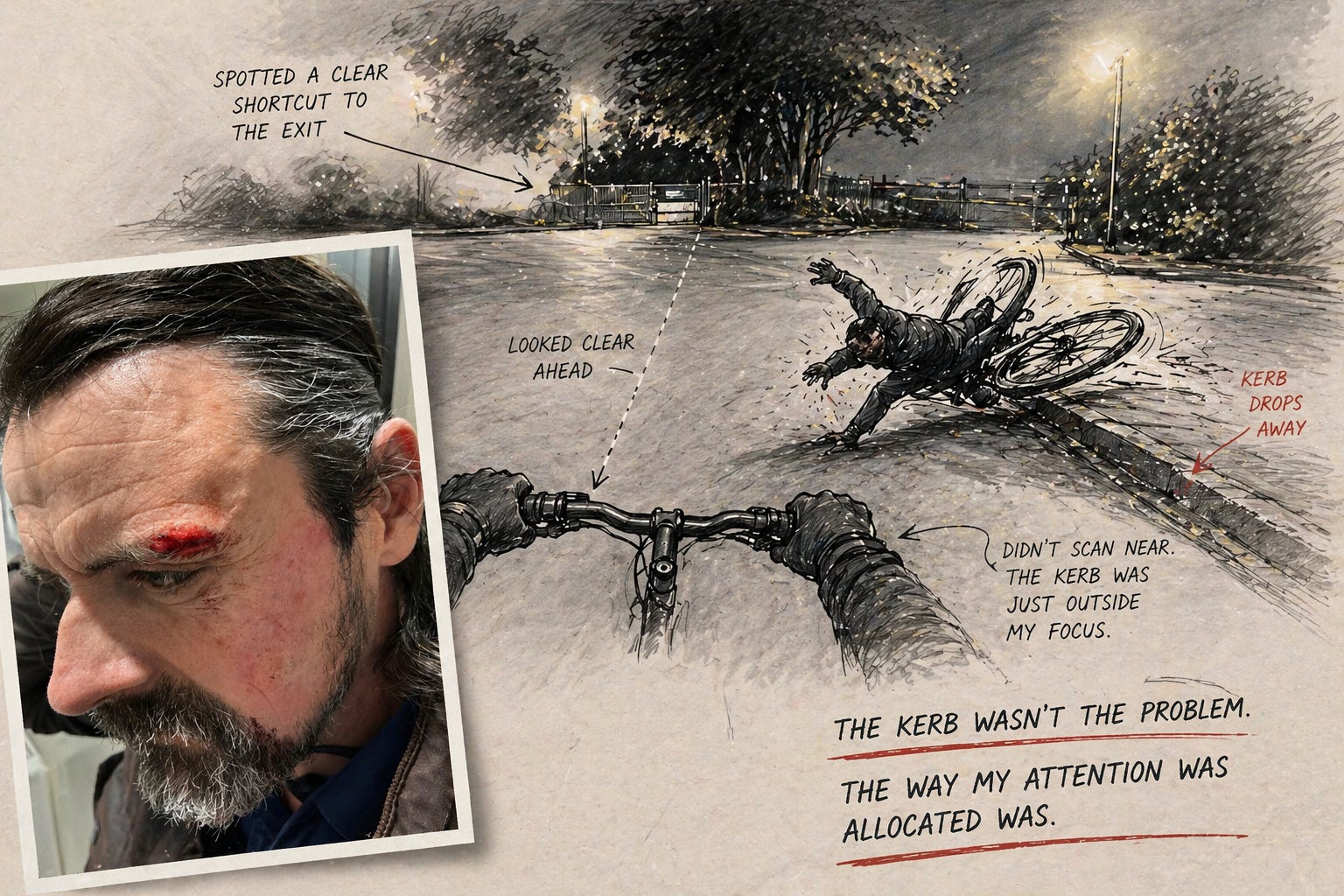
Through the fog of mild concussion that followed I reflected on what I had learned and how it applies to behavioural science.
It was dark. I spotted what looked like a clear shortcut across the space. I checked the path ahead and it looked unobstructed. I committed. A few seconds later I was on the floor looking up with my bike on top of me.
What I missed was a kerb that dropped away close to me.
Not hidden. Perhaps perceptually distorted by the shade of tree branches under the flood lighting. Just outside my focus.
That distinction matters.
We often fail to see the whole picture. We see what we are looking for.
In behavioural science, this offers a lived experience of inattentional blindness. When we fixate on a goal (in this case, the exit gate), our perceptual system prioritises information that confirms the path forward.
Other things can be invisible to us even when it is directly relevant and in plain sight.
I scanned ahead. I did not scan near. The kerb was not invisible; it was simply outside the frame I had constructed.
In business, this is common. Teams define their target; growth, efficiency, delivery speed, then orient attention around it. Risks that sit just outside that frame are systematically missed.
Not because they are hidden, but because they are not being actively scanned for.
My judgement was based on incomplete sampling. I checked one dimension (forward space) and implicitly assumed others (ground-level hazards, proximity risks) were also clear.
This is a form of heuristic substitution answering an easier question (“Can I see anything ahead?”) instead of the harder one (“Is the entire path, including near-field risks, safe?”).
In organisations, this shows up in due diligence that is directionally correct but incomplete. A project looks viable on headline metrics, so adjacent risks are assumed away.
Proximity risk is underestimated
The kerb was close to me. That is precisely why it was missed.
Humans may scan for distant, salient changes at the expense of subtle, proximal ones especially in low visibility conditions.
I was in a hurry to get home, my thoughts were on the busy main road beyond the car park. Attention can narrow under uncertainty and time pressure.
In business settings, the equivalent is near-field risk: operational details, execution dependencies, or small process flaws that sit “too close” to be scrutinised.
Strategic risks get airtime. Immediate, mundane risks are ignored until they cause failure or complications, such as compliance breach or a hidden cost.
Low visibility changes behaviour more than we admit
The contrast of floodlights and shade did not simply reduce visibility; it changed how I processed information. I relied more on assumption and less on verification.
There is strong evidence that under conditions of uncertainty, people default to faster, less effortful cognitive processes. In my case the uncertainty itself was not regarded as I confidently set off on a hazardous course.
Confidence does not necessarily drop in line with accuracy.
In business, “low visibility” takes many forms: incomplete data, time pressure, unfamiliar markets. The consistent pattern is over-reliance on partial signals.
The System Lesson
It is easy to frame this as an individual error. That is the wrong level of analysis.
The more useful question is: what would have reduced the likelihood of that error?
It would be easy for me to seek an external explanation to blame for my error. Car park design, lighting choices, yet on revisiting the scene a few days later, no apparent hazards were present. The world cannot be made 100% risk free, and organisations have limited control over their trading environment.
Decisions are made in complex and uncertain environments. They have to be made by people who are often in a hurry, fatigued and dealing with complexity.
I do not think I would make that same error again, in that car park or similar environments, because I now have a schema, a new frame of reference for what went wrong.
As humans we can learn from our own actions but also from the experiences of others, hence the reason I am sharing my embarrassing attempt at unpowered flight.
In business failures are often not the result of dramatic misjudgements. They are the accumulation of small, local oversights that sit just outside the decision-maker’s focus.
The kerb was not the problem. The way attention was allocated was.
That scales.
If your systems rely on people consistently noticing what sits just outside their immediate goal, you are building in avoidable risk.
Behavioural science is not just about influencing customers. It is about designing decision-making processes that reduce blind spots.
Shortcuts get a bad name, but another term for them are efficiency savings and these are celebrated when they work.
My efficiency gain failed. Not only did I spend time looking at the sky trying to work out what went wrong, but I lost another three hours at the hospital having my split eyebrow glued together.
Outcomes may be shaped by the environment, but performance depends upon how well you respond to it.